Troubleshooting
Mini Split Not Cooling? Here's How to Diagnose It
Diagnose a mini split that is not cooling safely, from settings and airflow to outdoor-unit, refrigerant, and pro-only faults.
A mini split that blows air but does not cool is not always a failed compressor. It may be in the wrong mode, starved for airflow, blocked outside, or trying to cool a room load it was never sized for. The best diagnosis is by elimination: confirm the system is being asked to cool, confirm air can move through both coils, then stop before you get into refrigerant or high-voltage work.
This guide is for U.S. homeowners with ductless mini split heat pumps. ENERGY STAR describes ductless systems as air-source heat pumps with an outdoor compressor/condenser and one or more indoor air-handling units.[1] Because cooling depends on both sides of the system, a problem at the indoor head or the outdoor unit can show up as “not cooling.”
First, know the DIY boundary
You can usually handle remote settings, filter cleaning, light debris removal around the outdoor unit, checking for blocked louvers, reading the manual, and replacing remote batteries.
Call a licensed HVAC technician for refrigerant leaks or charging, ice that returns after cleaning and thawing, repeated breaker trips, burning smells, persistent error codes, outdoor fan or compressor faults, control-board issues, and anything that requires opening electrical or refrigerant service panels.
Do not add refrigerant as a guess. A low charge usually means there is a leak or installation issue, and correct diagnosis requires tools, training, and compliant refrigerant handling.
Step 1: Make sure it is actually cooling
Many “no cooling” calls start with the remote. Check the simple settings before assuming a mechanical failure:
- Set mode to Cool, not Dry, Fan, Heat, or Auto.
- Set the temperature several degrees below the room temperature.
- Set the fan to medium or high for testing.
- Cancel sleep, economy, vacation, and timer modes.
- Aim the vane into the room, not into curtains, a soffit, or furniture.
- Replace weak remote batteries if commands seem inconsistent.
Wait several minutes after changing modes. Many systems delay compressor operation after a restart or mode change. Rapidly turning the unit on and off can make troubleshooting worse, not better.
If the air becomes cool after this step, the issue was settings-related. If airflow is present but the air still feels room-temperature, keep going.
Step 2: Check indoor airflow
A mini split cannot cool well if room air is not moving across the indoor coil. Stand under the indoor unit with the fan on high. If the airflow is weaker than normal, look for a clogged filter, blocked intake, closed louver, furniture in the discharge path, or heavy dust on the visible coil or blower wheel.
Most wall-mounted mini splits use washable mesh filters. Follow the owner’s manual: remove the filters, vacuum or wash dust off as directed, and let them dry before reinstalling. Manufacturer manuals commonly include operating modes, cleaning instructions, and safety warnings for the homeowner-level maintenance they expect owners to perform.[4]
The EPA’s home air-cleaner guidance makes the same practical point that applies here: filters need maintenance or replacement according to product instructions, and air-cleaning devices only help when air can pass through them.[3] On a mini split, a dirty filter can reduce comfort and may contribute to coil icing.
If airflow is still weak after the filters are clean, do not start dismantling the head unless your manual gives that procedure. A packed blower wheel, dirty coil, or motor problem may need professional cleaning or repair.
Step 3: Look for ice
Ice on the indoor coil or refrigerant lines is a symptom, not a fix. Turn cooling off and let the system thaw fully. Fan-only operation may help if your manual allows it, but do not chip ice off the coil.
Common causes include dirty filters, blocked indoor airflow, a dirty coil, a blower problem, low refrigerant from a leak, or a metering/sensor/control issue. The homeowner test is simple: clean filters, remove airflow restrictions, thaw the unit, and try cooling again. If ice returns, call a technician. Repeated icing points beyond normal owner maintenance.
Step 4: Check the outdoor unit without opening it
During cooling, the system moves heat from the house and rejects it outdoors. DOE’s Energy Saver guidance describes heat pumps as systems that transfer heat rather than create it directly.[2] If the outdoor coil cannot breathe, the house may not cool.
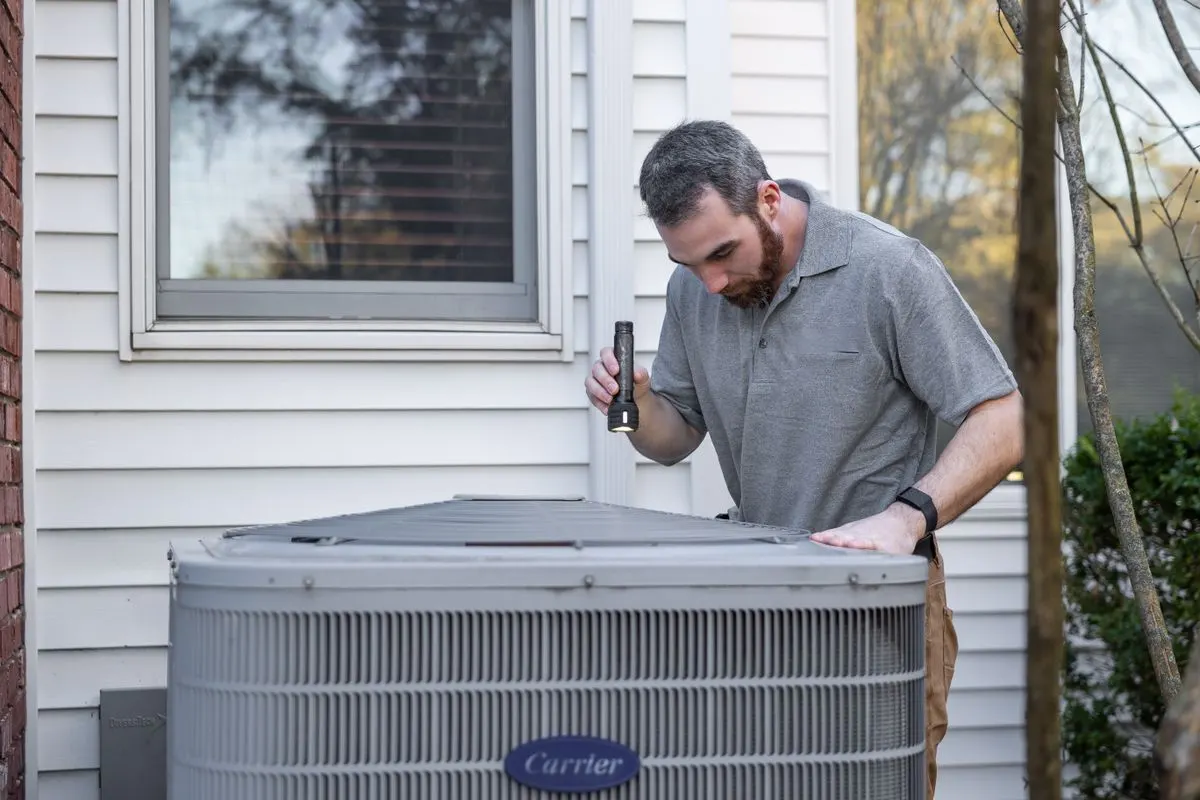
Walk outside while the indoor unit is calling for cooling. Check whether the outdoor fan is running and whether leaves, cottonwood, grass clippings, weeds, snow, plastic, or storage items are blocking the coil or discharge air. Also look for a fence, shrub, deck box, or cover that traps hot discharge air around the unit.
Do light cleanup only. Turn power off before removing debris near the fan or coil. Do not remove panels, reach into the fan area, or bend coil fins aggressively. Outdoor units contain high-voltage parts that are not homeowner-service items.
Step 5: Decide whether the load is the real problem
Sometimes the mini split is cooling, just not enough. Ask what changed:
- Is this the hottest or most humid part of the year?
- Are large windows uncovered in the afternoon?
- Are doors open to a hall, garage, basement, or other unconditioned area?
- Is one head expected to cool several rooms around corners?
- Did a new appliance, office setup, or occupancy pattern add heat?
- Has the system never cooled well since installation?
Mini split sizing depends on room load, insulation, air sealing, window exposure, placement, and layout. Avoid both common guesses: “it only needs more refrigerant” and “a bigger unit would always be better.” Oversizing can cause comfort and humidity problems, while undersizing can leave the system running constantly. If performance has never been right, ask for a proper load calculation and installation review.
Step 6: Read the error code before resetting everything
Many mini splits report faults with blinking lights, a wall-controller message, or a code retrieved through the remote. Write down the indoor and outdoor model numbers, the exact code or blink pattern, and what the system was doing when it appeared.
Then check the model-specific manual. Do not repeatedly clear the code before service; it may be the clue the technician needs. Codes involving communication, thermistors, inverter boards, fan motors, compressor protection, or electronic expansion valves are not solved by filter cleaning.
Step 7: Do not overlook condensate shutdowns
A cooling mini split removes moisture from indoor air, and that water must drain. A clogged drain or failed condensate pump can cause dripping, gurgling, water alarms, or shutdowns that look like poor cooling.
Look for water under the indoor head, a wet wall, a pump that runs constantly, a musty smell, or a visible blocked drain outlet. You can remove obvious blockage at the outlet, but avoid forcing high pressure into a line unless you know the system layout. Some installations use pumps, traps, or fittings that can be damaged or disconnected. If water is near electrical components, shut the system off and call for service.
Step 8: Consider refrigerant after settings and airflow are ruled out
Low refrigerant is possible, especially after poor installation, flare leaks, line-set damage, or corrosion. It should not be the first guess.
Signs that justify a refrigerant-side service call include strong indoor airflow but no cool supply air, repeated icing, weak cooling across all heads on a multi-zone system, oily residue near flare connections or service valves, or a gradual decline after filters and coils have been kept clean.
The right request is not “top it off.” Ask the technician to diagnose for leaks, repair the cause, evacuate if needed, and charge according to the equipment data and manufacturer procedure.
Step 9: Compare zones on a multi-zone system
If one outdoor unit serves several indoor heads, comparisons help. One head failing while others cool normally suggests a zone-specific issue: settings, filter, sensor, valve, communication, or line problem. All heads weak points more toward outdoor airflow, outdoor fan, compressor/inverter protection, refrigerant charge, or a system-wide control issue.
For a clean test, set all heads to cooling with similar set points. Some multi-zone systems cannot heat one zone and cool another at the same time, so mixed modes can create confusing symptoms.
Quick elimination checklist
Use this order:
- Set mode to Cool and lower the set point.
- Cancel timers, sleep, economy, and vacation modes.
- Set fan to medium or high.
- Clean and dry the indoor filters.
- Confirm intake, discharge, and louvers are not blocked.
- Check for ice; thaw fully if present.
- Clear light debris around the outdoor unit.
- Confirm the outdoor fan runs during a cooling call.
- Compare other zones if applicable.
- Record error codes before clearing them.
- Call a technician if cooling is still weak, ice returns, or the outdoor unit behaves abnormally.
What to tell the technician
Have the indoor and outdoor model numbers ready, plus the system age, single-zone or multi-zone layout, when the problem started, whether filters were cleaned, whether ice appeared, whether the outdoor fan runs, any error codes, and any recent power outage, landscaping, renovation, line-set damage, or prior refrigerant service.
That information helps the technician diagnose instead of guessing.
Bottom line
When a mini split is not cooling, start with mode, set point, filters, indoor airflow, outdoor airflow, and room load. Those checks are safe and often reveal the problem. Stop at refrigerant, electrical, persistent icing, and fault-code issues. If the system has strong airflow but the air is not cool, the coil keeps freezing, or the outdoor unit will not run normally, it is time for licensed service.
Sources used
- ENERGY STAR — Ductless heating and cooling overview: https://www.energystar.gov/products/ductless_heating_cooling
- U.S. Department of Energy, Energy Saver — Heat pump systems: https://www.energy.gov/energysaver/heat-pump-systems
- U.S. EPA — Guide to Air Cleaners in the Home: https://www.epa.gov/indoor-air-quality-iaq/guide-air-cleaners-home
- Daikin Comfort Technologies — Example ductless operation manual for operating modes, cleaning, and safety guidance: https://backend.daikincomfort.com/docs/default-source/product-documents/residential/manuals/operationmanuals/operation-manual-%28om%29---ftxb-b-rxb-b_ftx_k-b-rx_k-b-series.pdf?sfvrsn=67e3f26_8
- Pexels image — “Technician Inspecting Outdoor HVAC Unit” by Kathleen Austin Kuhn: https://www.pexels.com/photo/technician-inspecting-outdoor-hvac-unit-32497161/
Frequently Asked Questions
Why is my mini split running but not cooling?
Start with the simple causes: the unit may be in the wrong mode, the set temperature may be too high, the filters or indoor coil may be dirty, or the outdoor unit may be blocked. If airflow is normal but the air is not cooling, shut the system down and call a licensed HVAC technician because refrigerant or electrical faults may be involved.
Can a dirty filter make a mini split stop cooling?
Yes. A dirty filter can reduce indoor airflow, which can make the room cool slowly, cause weak air at the indoor head, and in some cases contribute to coil icing. Clean the washable filters according to the manufacturer instructions and let them dry fully before reinstalling.
Should I add refrigerant to my mini split myself?
No. Low refrigerant usually means there is a leak or installation issue, and handling refrigerant requires proper equipment and certification. Call a licensed HVAC technician to leak-check, repair, evacuate, and charge the system according to the equipment data and local rules.
How long should I wait before deciding the mini split is not cooling?
Give the system several minutes after changing modes or lowering the set point, and longer if the room is very hot or humid. If the supply air never becomes cooler, airflow is weak, the coil ices, or the unit shows an error code, move through the checklist or call for service.